
1. Overview of construction method
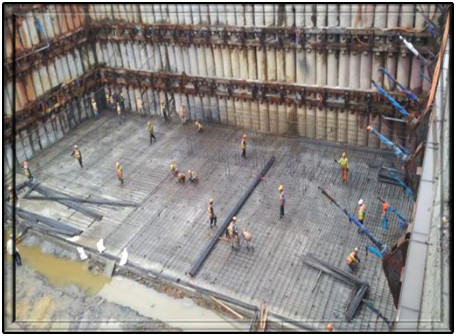
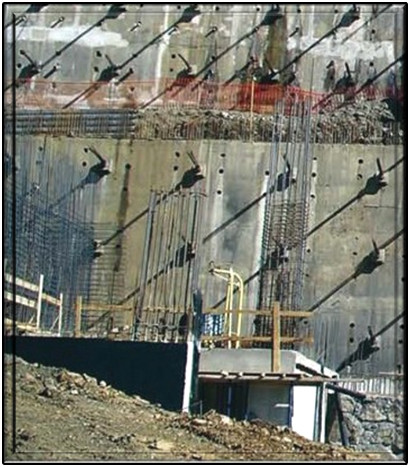
The main purpose of the Earth Anchor method is to excavate the back of an earth retaining wall in a cylindrical shape and install an anchor to support the surrounding ground.
The function of an anchor is to anchor a structure to the ground through tension members, and there are similarities with piles in terms of support mechanisms. However, in the case of anchors, they are usually fixed by applying design is simple.
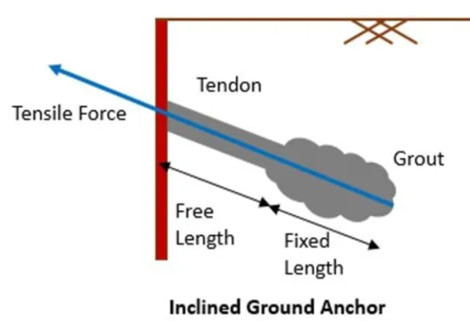
Completely different from drawn piles, anchors are composed of the following three components in the force transmission path.
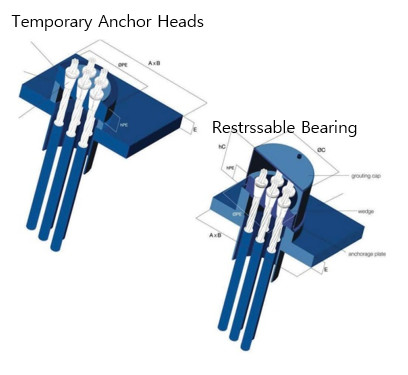
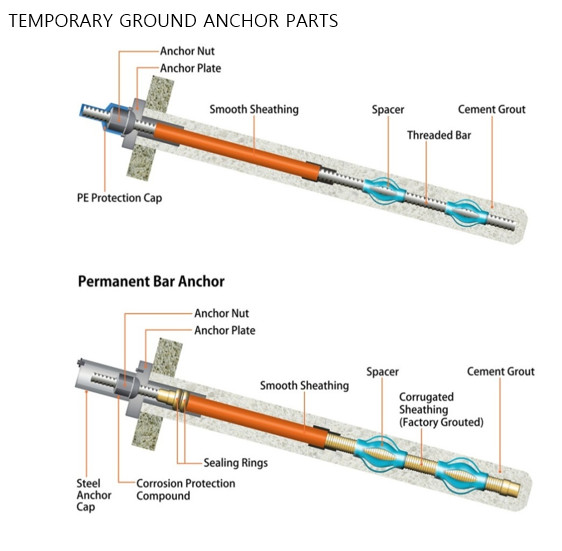
1) Anchor Head
The force in the structure is a simple tensile force, which is intended to be transmitted to the tensile part without difficulty. It is composed of the fixing(fixing) hardware of the tensile member, an acupressure plate, and a placenta area, and serves to and adjust distribute the concentrated force of the anchor the direction to fix it. do.
2) Tensile part
It is a part for transmitting the tensile force from the head of the anchor to the anchor body provided in the ground. It is usually made of PC steel wire as the main material, and the free field is insulated from the ground or structure by sheaths and caissons and has a structure that can expand and contract freely.
3) Anchor body
It is a part of a tensile material that is prepared to transmit tensile force to the ground according to the frictional resistance with the ground, and in most cases, it is composed of a cement-based compound.

PERMANENT ANCHOR
|
|
Type of Anchor Ground anchor can be categorizedby service period, supporting method, installation angle or injection, pressing method of grout material. Depending on the service period, anchor sare divided into temporary anchor and permanent anchor. |
|
|
Temporary anchor is widely used to tempororary support soil-cement blocks or ground, while permanent anchor is for stabilization of slopes or prevention of roll-over and damage of permanent structures. |
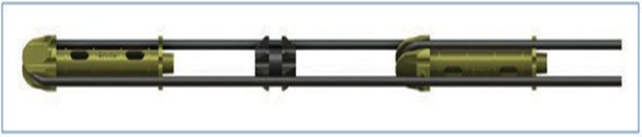
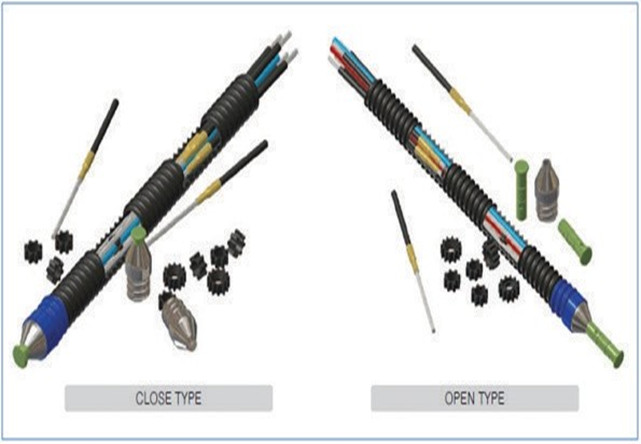
Depending on the support method of ground, it can be di vided into frictional type anchor, pressure type anch or and complex type anchor. Frictional type anchor is supported by friction between grout and ground, and thus further categorized into tensioning anchor and pressing anchor, by the way the load is applied on the grout. Based on the load distribution, it can be divided to load-centric type anchor and load-distributing type anchor.
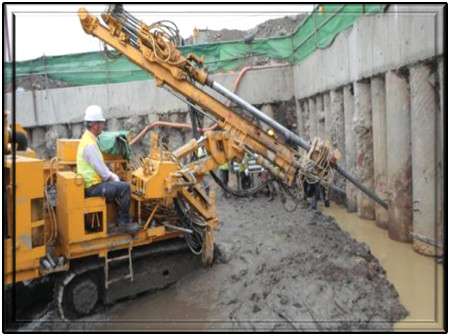
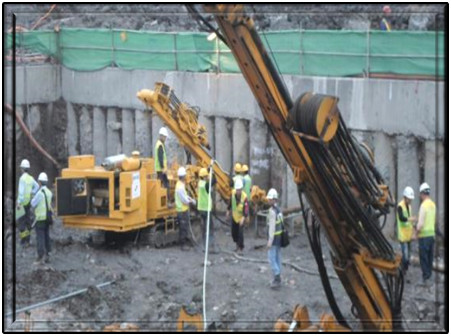
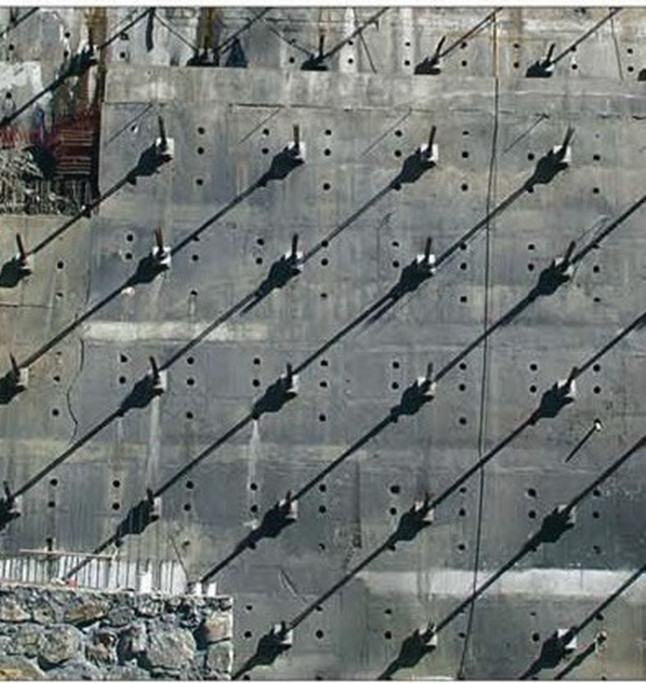
2. Use (Application) of Earth Anchor
Construction method
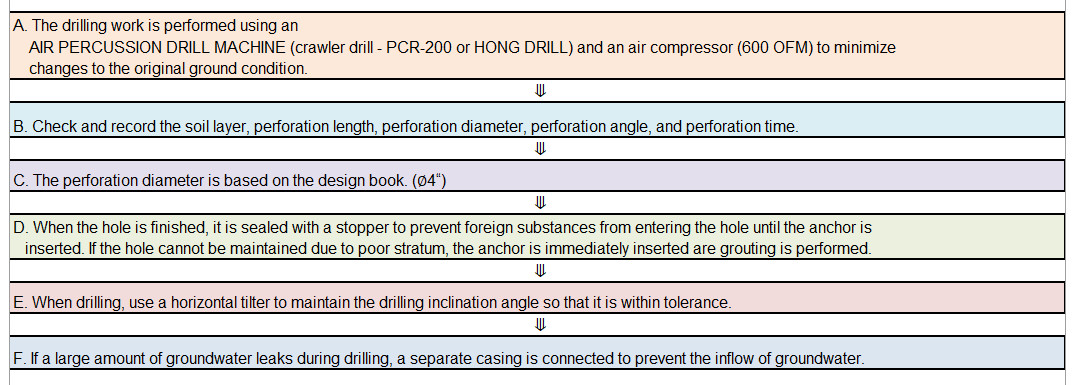
1) Drilling
2) Manufacturing and installation of ANCHOR main body
A. ANCHOR: PC steel wire ∅12.7mm
B. Length: In accordance with design requirements
C. PC steel wire uses Design standard products and sufficient manufacturing facilities are secured.
D. PC steel wire is cut accurately and finished cleanly, and is manufactured to the size and specifications specified in the design.
E. Assembly is in accordance with the design, and rust and foreign substances attached to the strand must be removed.
F. When inserting a tension member, the excavation hole is completely cleaned and then inserted deep into the anchorage site.
G. When inserting the tension member, insert it slowly to prevent the cavity wall from collapsing.
H. The tension member must be securely fixed so that its position does not move during grouting, and must be located in the center of the hole.
I. The installation angle of the anchor is (30 degrees) and the free anchorage is in accordance with the design.
J. The anchor method follows site specifications, but as a standard, ϕ12.7 (4 strands) strands are used, and the allowable tensile force and maximum tensile force of each strand are as follows.
K. Cover the free area with an industrial water tent hose to prevent grout.
| Type | Allowable tension stress | Maximum Tensile Stress | Remark |
| ⌽12.7 | 11.2 t | 18.7 t |
3) Grouting
A. Grouting starts at the end of the ball and allows the groundwater and air inside the hole to be discharged to the outside.
B. During the first injection, limit the injection pressure to prevent destruction of the base ground.
C. The Grout Hose uses a material that can withstand a maximum pressure of 20 Bar, and its size is ∅13mm.
D. During the second injection, a free field is maintained.
E. After grouting, do not apply tension or impact to the anchor body until the required strength is achieved.
F. After curing is completed, conduct a tensile test to check whether the tensile force of the anchorage is secured as designed
G. If the test result fails, re-construction is carried out, and if the test results pass, the tension member, which is a PC steel wire, is fixed to the bracket.
4) Curing
A. In principle, curing is done for 7 days (curing period can be shortened when using quick-curing agent), and when installing beams and strips, care must be taken with underground water and strands.
5) Tensile work
A. Once the acupressure plate installation is complete, the cone is assembled and tensioning work is performed.
B. When performing tensioning, check the state of the cylinder of the tensioner and the amount of stretching of the steel wire, and then tension and settle until the pressure reaches about 120% of the design load.
C. For several anchors that are installed for the first time and anchors in location where the construction has changed, a tensile est must be performed under the direction of the supervisor to measure the elongation of the anchors to ensure safety.
D. When the anchor is tense, workers are prohibited from accessing the back of the jack for safety reasons.
E. Secure and install an extra length for tension, and do not cut the extra length in preparation for re-tensioning.
F. Continue repeating until the Desing requirement tension of tension is achieved.
G. When the lower anchor is tensioned, the upper anchor must be tensioned to compensate for the relaxation of the tension of the upper anchor.
H. This is done only when it is necessary to know the ultimate pulling force in advance to check whether the assumptions such as soil constants used in the design of the anchor body are valid or not.
I. The tensile test is conducted on equivalent conditions to the anchor actually provided or on a previously constructed anchor.
J. The planned maximum load is 95% of the tensile member's yield strength or 80% of the crushing strength, whichever is smaller.
K. If the PC strand comes out during the test, it is considered the limit load.

