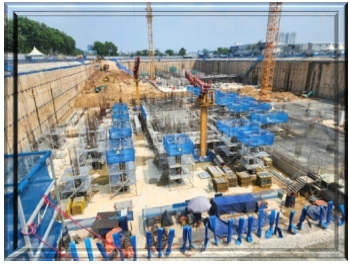
Temporary Works & Finishing – KR VINA provides scaffolding, formwork, masonry, plastering, tiling, painting and ceiling/floor installation for all types of industrial and civil construction projects.
Temporary works and finishing works comprise essential construction facilities ensuring safety and delivering architectural interior and exterior aesthetics.
1. Temporary Works
▫ Scaffolding: Heavy-duty modular metal frames enabling safe work at heights. ▫ Formwork: High-rigidity formwork systems shaping reinforced concrete elements. ▫ Site Fencing: Securing construction perimeters and public safety. ▫ Access Roads: Heavy-load temporary haul roads and material staging yards.
2. Finishing Work
▫ Masonry Work: Precision block and brick wall installations. ▫ Plastering & Tiling: Surface rendering and ceramic/stone wall and floor tiling. ▫ Painting & Coating: Protective, waterproof and aesthetic paint finishes. ▫ Drywall Partitions: Modern lightweight drywall systems. ▫ Suspended Ceilings & Flooring: Specialized acoustic ceilings and epoxy/timber floors.
"1. Ground (Earth) Anchor
The ground Anchors are basically devices used to transmit the forces to the soil by means of prestressed tendons to anchor the Structure to the ground or to retain the slopes from collapsing.The ground anchor can be used to stabilise a retaining wall by transferring the forces caused by the natural thrust of the ground and the working loads beyond the slip circle. Forces are transmitted to the ground via the bond length. It is generally prestressed to control the movement of the retaining wall during the various construction phases.Earth anchors are used in both temporary or permanent applications, including supporting retaining walls, guyed masts, and earth retaining wall.
2. Rock Anchor
The rock anchors in civil and mining structures to counteract uplift forces acting on foundations and post-tension existing concrete structures. Rock anchors are made of high tensile steel, and typically they are anchored in sound bedrock by means of high strength cementitious grouting for foundations and through holes drilled into or through a structure for post-tensioning applications. For most applications the rock anchors are tensioned to a force higher than what is necessary to resist the foundation uplift force. When no tensioning is applied to the rock anchors they are called rock bolts. Both rock anchors and rock bolts are eventually grouted on their full length, however rock anchors may be grouted in two steps to allow for a certain free tensioning length after the first step.
3. Vertical (Buoyancy prevention) Anchor
The Vertical(buoyancy prevention)anchor method is to stabilize the structure against excessive stress, deformation, displacement, etc. that occurs in the structure by installing permanent anchors on the foundation floor and lower rock layer and fixing both ends for the buoyant part that is not in balance with the dead load of the structure. In this method, the stability of the structure's buoyancy, the internal stability of the anchor, the stability of the tensile member's design load, the stability of the adhesion between the grout and the rock, and the stress holding capacity according to load and time must be carefully reviewed, especially over time.
"Chemical grouting is an injection technology introducing solution-type and suspension-type grout into weak soil to achieve superior water stopping and ground reinforcement.
1. Technology Overview
The most common form of chemical grouting is permeation grouting, which involves filling joints or cavities in rock or granular soils with specialized chemical grout formulations.When used in granular soils, structural chemical grouting permeates the spaces between soil particles, binding them together and significantly enhancing the soil's bearing capacity and shear strength.
2. Materials and Process
Advanced chemical grouts are selected per ground conditions:▫ Solution-type: Sodium silicate and polyurethane resins penetrating fine fissures.▫ Semi-suspension: Micro-fine cement with chemical accelerators for controlled gel time.▫ Suspension: Modified cement slurries for sealing large voids and groundwater inflow.
3. Features and Applications
▫ High-efficiency groundwater cut-off for deep excavations, basements and tunnels.▫ Underpinning foundations and stabilizing soil surrounding structures with zero vibration.▫ Applicable in confined indoor areas and low-headroom work zones.
"Deep Cement Mixing (DMM) stabilizes weak and compressible soils at depth by mechanically blending in situ soil with cementitious slurry.
1. Technology Overview
The Deep Cement Mixing (DMM) method uses mechanical mixing augers to blend soft soils at depths up to 20m - 30m with cement slurry.Hydration of the cement creates high-modulus, high-strength soilcrete columns that dramatically reduce settlement and increase overall bearing capacity.
2. Construction Sequence
▫ Step 1: Positioning the mixing machine over the column coordinate.▫ Step 2: The mixing blades penetrate down to the designed competent bearing stratum.▫ Step 3: Cement slurry is pumped while counter-rotating blades thoroughly mix the soil.▫ Step 4: Controlled retrieval of the mixing stem ensuring uniform column diameter.
3. Applications
▫ Highway embankments, ports, airport runways over soft clay.▫ Slope stability reinforcement and cutoff walls for deep excavations.▫ Mitigation of post-construction differential settlement.
"Hotdog Ground Anchor is a state-of-the-art retaining system applied by KR VINA, providing optimum lateral support for deep excavations in complex urban geological formations.
1. Technology Principle
Ground anchors restrain lateral movements of retaining structures by transmitting tensile loads deep into competent bearing strata.The Hotdog Anchor utilizes specialized mechanical expansion and high-pressure jetting to create an enlarged bulbous bond zone (resembling a hotdog). This increases soil-grout frictional contact area by 2.5 to 3.0 times compared to conventional cylindrical anchors.
2. Key Advantages
▫ Superior Pullout Resistance: Withstands substantially higher design tensile capacities with shorter drilling depths.▫ Cost & Schedule Savings: Reduces total anchor drilling quantities by 30% to 40%.▫ Strict Deformation Control: Minimizes wall deflection, safeguarding adjoining urban infrastructure.
3. Applications
▫ Diaphragm wall and sheet pile tieback systems for high-rise basements.▫ Highway slope stability and hillside landslide remediation.▫ Tension anchors resisting hydrostatic uplift for underground structures.